
 Image 1 of 4
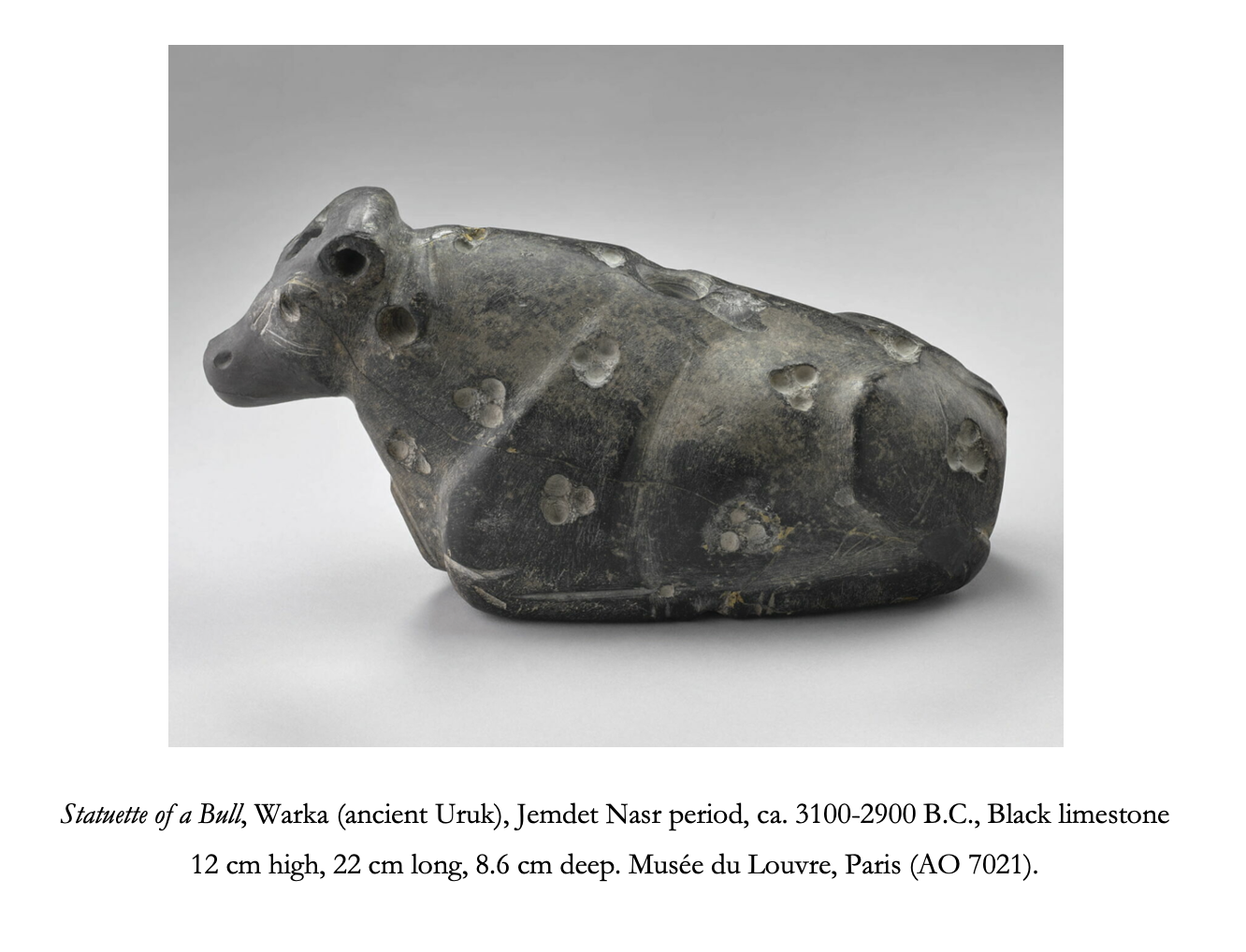 Image 2 of 4
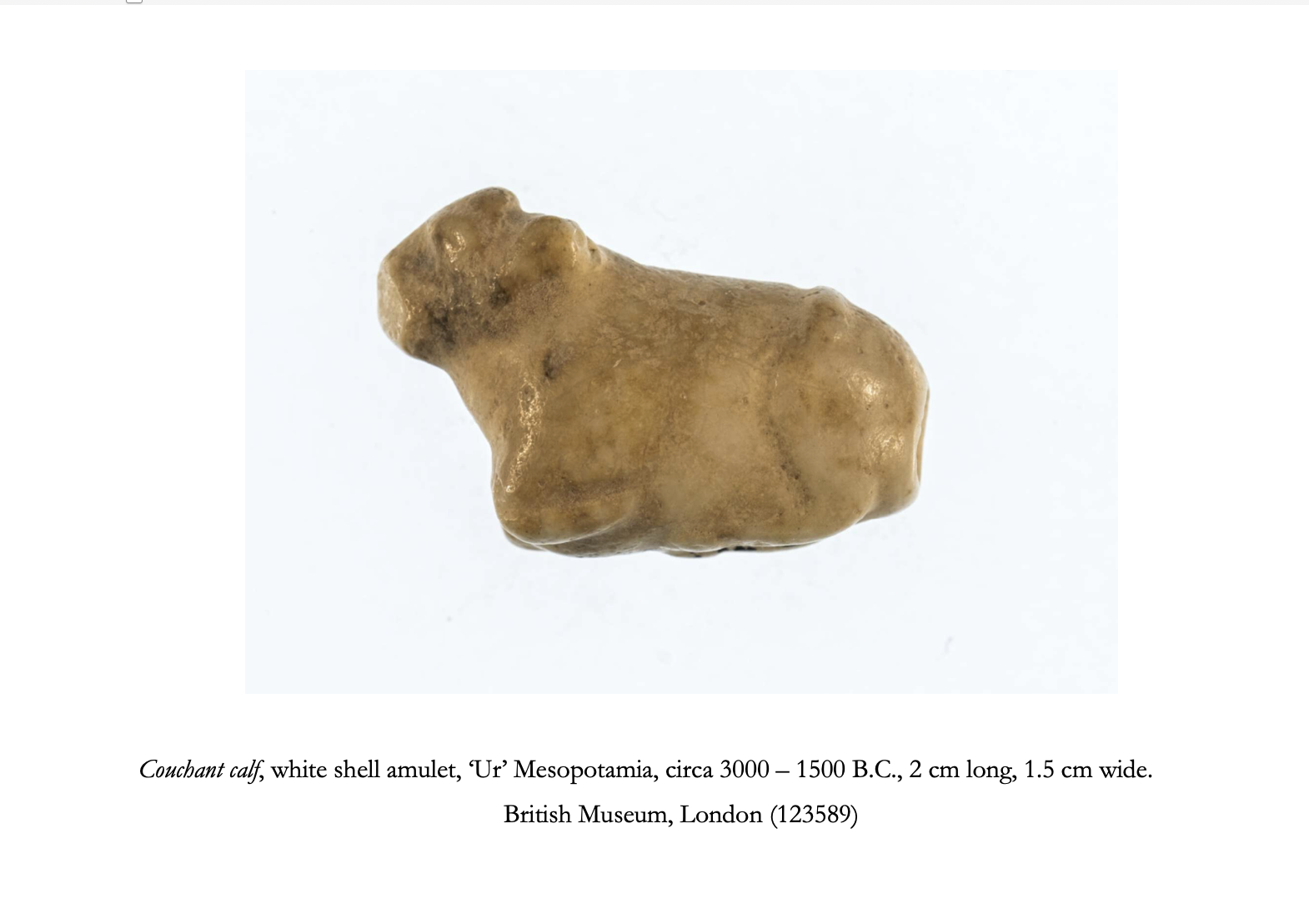 Image 3 of 4
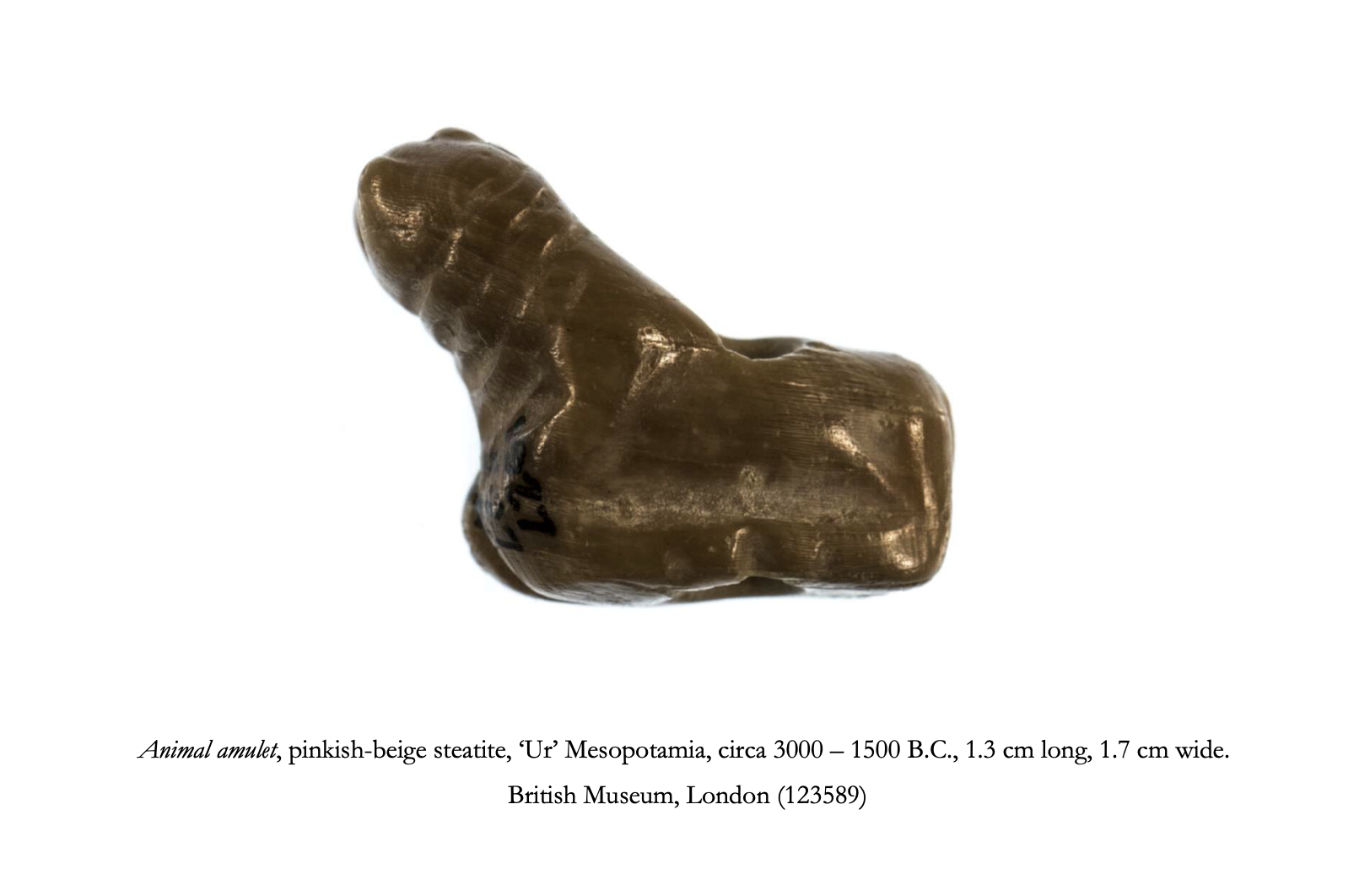 Image 4 of 4
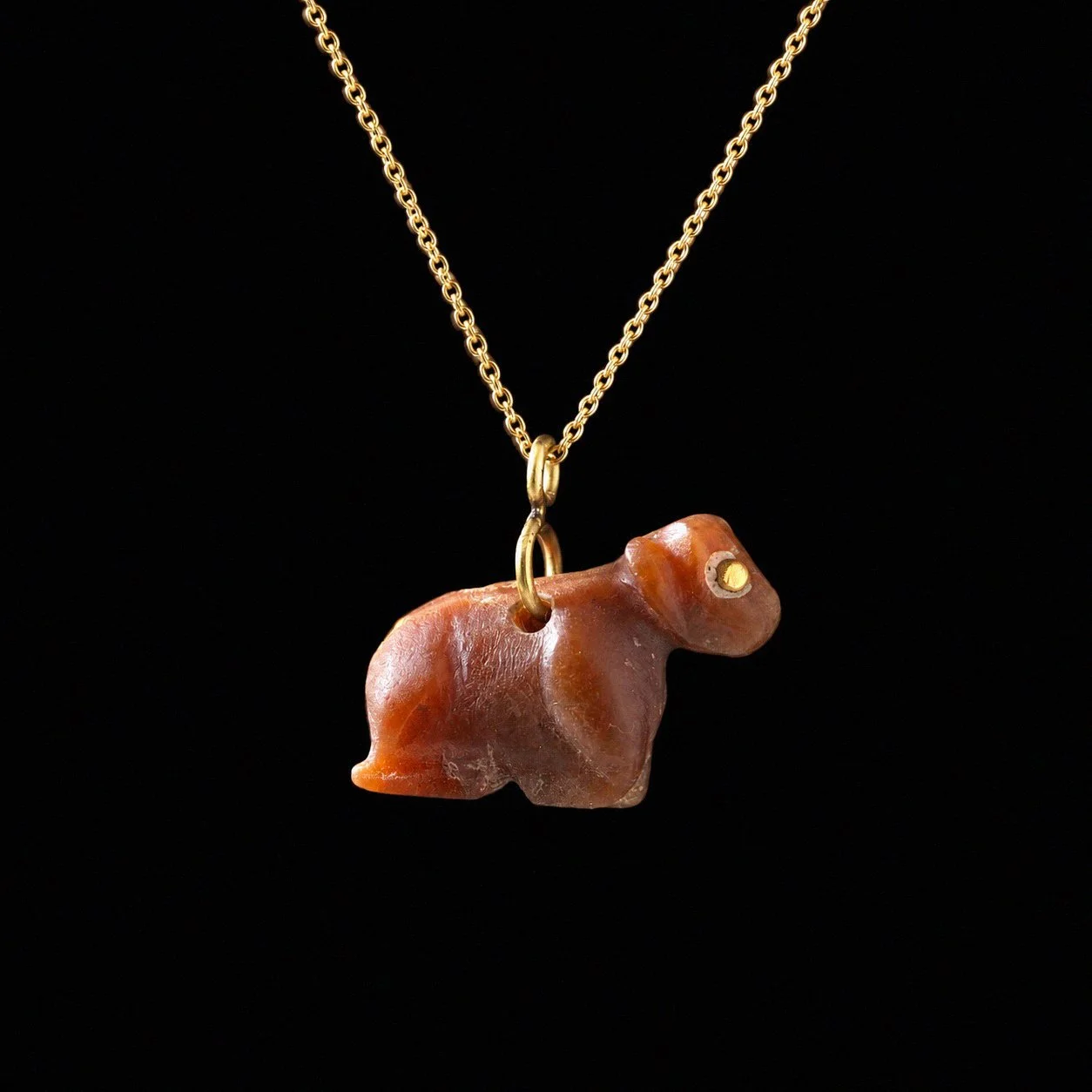
Ancient Mesopotamia, circa 3000 - 1500 B.C.
Steatite (soapstone),
Set on a 18ct gold chain, with handmade clasp and fittings,
hallmarked and stamped
2.8 cm wide (amulet)
1.8 cm high
Provenance:
Private collection, 1970s - 1990s;
Collection of Prince Sheikh Saud bin Muhammed Al Thani (1966 - 2014);
Thence by descent.
This charming steatite (soapstone) amulet is carved into the form of a calf, or a bull. It finds comparisons with a larger statuette of a bull in the Louvre, which hails from the same period and geographical region of ancient Mesopotamia. Our example retains one of its gold inlays in the eye socket, which the Louvre example appears to have also originally possessed, but which only the empty cavities remain. Even more similar examples exist in the British Museum, a ‘couchant calf’ probably carved from a white shell and a steatite amulet of a non-descripted seated animal. Both of those were excavated by Sir Leonard Woolley in the Mesopotamian city of Ur.
The recumbent calf or bull is one of several animal types that were popular as small sculptures, amulets and stamp seals in the late fourth millennium B.C. at the sites of the ancient cities of Ur, Uruk, Sumer and throughout Mesopotamia more widely. Ancient Mesopotamia, situated in the land between the Tigris and Euphrates rivers, is often referred to as ‘the cradle of civilisation’. Its advancement was initially powered by the fertility of this land and its agricultural dominance, which is symbolised by the seated bull. Affluence in this area, together with the invention of organisational and bureaucratic systems of governance allowed them to create a genuine social order, as well as building the first cities (3500 B.C.), the formalisation of writing and the first recording of ‘history’. Mesopotamia also produced some of the most powerful and captivating art of antiquity and led the world in astronomy, mathematics, and other sciences - a legacy that lives on today.
Although lacking in minerals and semiprecious stones, ancient Mesopotamian sites have yielded a great deal of such finery, which from the third to the first millennium B.C. comprised imported materials: gold, sliver, lapis azuli, cornelian, malachite, green and red jasper, chalcedony, hematite, amazonite, banded calcite, chlorite, steatite, white and black limestone, pink or speckled bryozoan limestone and even rock crystal, bone, ivory, and from the mid-second millennium, glass. Many of these stones were imported from the Iranian plateau, the Persian Gulf, Central Asia and the Indus Valley to the east, and Anatolia, the Levant, and Egypt to the west, many of these stones were worked where they were mined. Raw materials also travelled to Mesopotamia in unworked form. While they did not incorporate any stones that are considered precious today these rare ornaments remind us that in Mesopotamia, stones derived their value not only from their origin, but also from their colour and the magical properties that were attributed to them.
Beyond the development of techniques and bead shapes, they bear witness to the refinement of Mesopotamian jewellery and the taste for the combined colours of gold, the brilliant blue of lapis lazuli, and the red of cornelian. The jewellery found at Khorsabad, for example, comprises a very wide variety of beads, facilitated by the Assyrian Empire's power and access to sources of supply.
Preferring precious metals and coloured stones imported from near and far, men and women who could afford them wore (and were buried with) necklaces, earrings, rings, bracelets, and other jewellery, both on their clothes and in their hair, including many appliqués and thin strips of gold leaf.